DMVCFramework — Delphi REST API, JSON-RPC & Web App Framework
The #1 most popular open-source Delphi framework on GitHub · Production-ready since 2010
TL;DR: DMVCFramework is the #1 Delphi framework for building REST APIs and web services. It’s free (Apache 2.0), production-ready since 2010, supports JWT, WebSocket, ORM, and works on Windows/Linux. Install from GitHub, create a controller with
[MVCPath]attributes, and return objects that auto-serialize to JSON.
What is DMVCFramework?
DMVCFramework (DelphiMVCFramework) is the most popular open-source framework for building web APIs and web applications in Delphi. It enables you to create RESTful services (RMM Level 3), JSON-RPC services, server-side web pages, mobile backends, and microservices with ease.
Used in production since 2010, DMVCFramework powers some of the highest-traffic Delphi web APIs in the world. It’s the #1 Delphi project on GitHub by star rating, with a vibrant community of 5,000+ active developers.




Get Started: The Official Guide
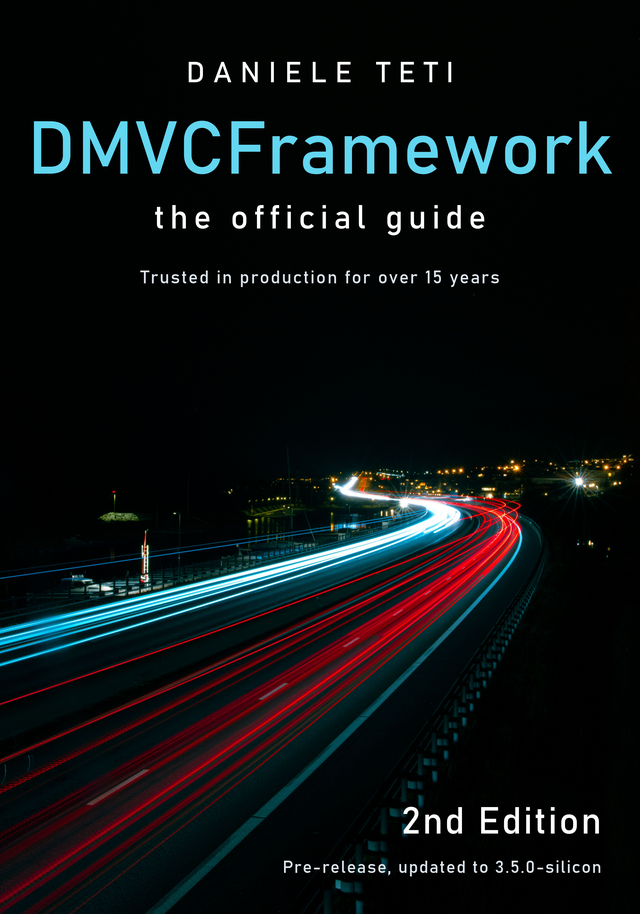
The fastest way to learn DMVCFramework is the official guide, written by the person who maintains the framework. The second edition is written on dmvcframework-3.5.0-silicon: 30 chapters, more than 550 pages and 46 sample projects that compile, building one API from the project the wizard generates up to a server behind TLS.
It is out on Leanpub at 90%, minimum price 45 USD, and updates are free forever.
Available Editions
| Edition | Language | Format | Link |
|---|---|---|---|
| 2nd, 3.5.0-silicon | English | eBook | Buy on Leanpub |
| 1st, 3.2.1-carbon | English | eBook | Buy on Leanpub |
| 1st, 3.2.1-carbon | English | Hardcover | Buy on Lulu |
| 1st, 3.2.1-carbon | Portuguese (BR) | eBook | Buy on Leanpub |
| 1st, 3.2.1-carbon | Spanish | eBook | Buy on Leanpub |
The second edition is English only for now, so the first edition stays the one to buy in Portuguese or Spanish, and the only one in print until the new one reaches Lulu.
Read a free sample of the second edition, or see the full table of contents.
Why Choose DMVCFramework?
| Benefit | Description |
|---|---|
| Proven in Production | Used since 2010 in small, medium, and enterprise projects worldwide |
| Complete Feature Set | REST, JSON-RPC, JWT, WebSocket, SSE, ORM - everything you need |
| Blazing Fast | Optimized for high performance under heavy workloads |
| Easy to Learn | Intuitive API with 50+ samples to get you productive quickly |
| Active Community | 6,000+ developers in the Facebook group ready to help |
| Actively Maintained | Regular updates, semantic versioning, future-proof |
What Developers Say
“DMVCFramework is a great framework. It’s very intuitive, fast, easy to use, actually there is nothing more to ask for.”
— Samir
“I’m still amazed by the DelphiMVCFramework code and documentation. Thank you very much and I am amazed by your quick feedback.”
— Benjamin Y., Director of SQLGate
“We started the process of migrating our systems to micro services and are loving the DMVCFramework.”
— E. Costa
What’s New in DMVCFramework 3.4.3-aluminium
The latest release brings major new features:
WebSocket Support
Full-duplex real-time communication with TMVCWebSocketServer and TMVCWebSocketClient. Build chat applications, live dashboards, and collaborative tools with channel-based messaging and groups.
Rate Limiting Middleware
Protect your APIs from abuse with built-in rate limiting - both in-memory for single servers and Redis-backed for distributed environments.
Repository Pattern
Clean architecture with IMVCRepository<T> and [MVCInject] for automatic dependency injection.
Expression Support in dotEnv
Dynamic expressions in .env configuration files with variable substitution and arithmetic.
See full What’s New for 3.4.3-aluminium →
Version History
| Version | Date | Highlights |
|---|---|---|
| 3.4.3-aluminium | Jan 2026 | WebSocket, Rate Limiting, Repository Pattern, Delphi 13 |
| 3.4.2-magnesium | Feb 2024 | Middleware Sessions, Database Sessions |
| 3.4.1-sodium | Jan 2024 | Sempare Templates, Delphi 12, foVersion |
| 3.4.0-neon | Sep 2023 | Functional Actions, Named Queries, HTMX |
| 3.3.0-fluorine | Apr 2023 | Delphi 11.3, Prometheus, Records in Swagger |
| 3.2.3-radium | Feb 2022 | Built-in Profiler, JSONRPC TObject |
| 3.2.2-nitrogen | Sep 2020 | Delphi 11, TMVCRESTClient, LRU Cache |
| 3.2.1-carbon | Nov 2019 | Official Guide Reference, snake_case |
| 3.2.0-boron | Jul 2019 | Delphi 10.4, Swagger, Nullable Types |
| 3.1.0-lithium | Mar 2019 | Enhanced Middleware |
| 3.0.0-hydrogen | 2018 | MVCActiveRecord ORM, 3.x Architecture |
| 2.x | 2015-2017 | Foundation Series |
Key Features
Web API Development
- RESTful APIs - Full RMM Level 3 compliance with proper HTTP verbs and status codes
- JSON-RPC 2.0 - Automatic object remoting for RPC-style APIs
- OpenAPI Support - Automatic API documentation generation
- Automatic Routing - Attribute-based URL mapping with parameter binding
Authentication & Security
- JWT Authentication - Industry-standard JSON Web Tokens
- HTTP Basic Authentication - Simple username/password auth
- Custom Authentication - Flexible framework for any auth scheme
- CORS Support - Cross-origin resource sharing configuration
Real-Time Communication
- WebSocket Support - Full-duplex communication channels
- Server-Sent Events (SSE) - Push notifications to clients
- Messaging Extensions - Built-in pub/sub patterns
Data & Persistence
- MVCActiveRecord - Powerful ORM for database operations
- JSON Serialization - Automatic object-to-JSON mapping
- Custom Serializers - Full control over data transformation
Deployment Flexibility
- Windows Console Application
- Windows Service
- Linux Console/Daemon
- Apache Module (mod_proxy)
- IIS (ISAPI DLL)
- Load-balanced environments
Developer Experience
- IDE Wizard - Project templates for quick start
- 50+ Samples - Learn every feature with working examples
- Middleware System - Easy request/response hooks
- Controller Inheritance - DRY principle for common logic
- Integrated REST Client - Test and consume APIs easily
Quick Start: Hello World
Get started with DMVCFramework in minutes. Here’s a simple “Hello World” controller:
uses
  MVCFramework, MVCFramework.Commons;

type
  [MVCPath('/api')]  // Base path for all actions in this controller
  TMyController = class(TMVCController)
  public
    [MVCPath('/hello')]           // Route: GET /api/hello
    [MVCHTTPMethods([httpGET])]   // Allowed HTTP method
    function GetHello: String;

    [MVCPath('/hello/($Name)')]   // Route: GET /api/hello/{Name}
    [MVCHTTPMethods([httpGET])]   // ($Name) captures the URL segment
    function GetHelloName(const Name: String): String;
  end;

implementation

function TMyController.GetHello: String;
begin
  Result := 'Hello, World!';  // Automatically serialized to JSON
end;

function TMyController.GetHelloName(const Name: String): String;
begin
  Result := 'Hello, ' + Name + '!';  // Name is automatically extracted from URL
end;
That’s it! Call GET /api/hello and you get "Hello, World!". Call GET /api/hello/John and you get "Hello, John!".
DMVCFramework automatically serializes your return values to JSON - strings, objects, arrays, records, datasets - everything just works.
Advanced Example: REST API with Database
For real-world applications, DMVCFramework supports MVCActiveRecord ORM and the Repository pattern with dependency injection:
uses
  MVCFramework, MVCFramework.Commons, MVCFramework.ActiveRecord,
  MVCFramework.Repository, System.Generics.Collections;

type
  // Entity class mapped to database table
  [MVCTable('customers')]
  TCustomer = class(TMVCActiveRecord)
  private
    [MVCTableField('id', [foPrimaryKey, foAutoGenerated])]  // Auto-increment PK
    FID: NullableInt32;
    [MVCTableField('name')]    // Maps to 'name' column
    FName: string;
    [MVCTableField('email')]   // Maps to 'email' column
    FEmail: string;
  public
    property ID: NullableInt32 read FID write FID;
    property Name: string read FName write FName;
    property Email: string read FEmail write FEmail;
  end;

  [MVCPath('/api/customers')]
  TCustomerController = class(TMVCController)
  protected
    fRepository: IMVCRepository<TCustomer>;  // Repository interface
  public
    [MVCInject]  // Dependency injection - repository is automatically provided
    constructor Create(Repository: IMVCRepository<TCustomer>); reintroduce;

    [MVCPath]                     // Route: GET /api/customers
    [MVCHTTPMethods([httpGET])]
    function GetAllCustomers: IMVCResponse;

    [MVCPath('/($ID)')]           // Route: GET /api/customers/{ID}
    [MVCHTTPMethods([httpGET])]
    function GetCustomerByID(const ID: Integer): IMVCResponse;

    [MVCPath]                     // Route: POST /api/customers
    [MVCHTTPMethods([httpPOST])]  // [MVCFromBody] deserializes JSON body to TCustomer
    function CreateCustomer([MVCFromBody] const Customer: TCustomer): IMVCResponse;

    [MVCPath('/($ID)')]           // Route: DELETE /api/customers/{ID}
    [MVCHTTPMethods([httpDELETE])]
    function DeleteCustomerByID(const ID: Integer): IMVCResponse;
  end;

implementation

constructor TCustomerController.Create(Repository: IMVCRepository<TCustomer>);
begin
  inherited Create;
  fRepository := Repository;  // Store injected repository
end;

function TCustomerController.GetAllCustomers: IMVCResponse;
begin
  Result := OKResponse(fRepository.GetAll);  // Returns HTTP 200 with JSON array
end;

function TCustomerController.GetCustomerByID(const ID: Integer): IMVCResponse;
begin
  Result := OKResponse(fRepository.GetByPK(ID));  // Returns HTTP 200 with JSON object
end;

function TCustomerController.CreateCustomer(const Customer: TCustomer): IMVCResponse;
begin
  fRepository.Store(Customer);  // Insert or update based on PK
  Result := CreatedResponse('/api/customers/' + Customer.ID.Value.ToString);  // HTTP 201
end;

function TCustomerController.DeleteCustomerByID(const ID: Integer): IMVCResponse;
var
  lCustomer: TCustomer;
begin
  lCustomer := fRepository.GetByPK(ID);  // Load entity by primary key
  fRepository.Delete(lCustomer);          // Delete from database
  Result := OKResponse;                   // Returns HTTP 200
end;
Key benefits:
- Functional actions: Return
IMVCResponseusing helpers likeOKResponse(),CreatedResponse() - Dependency injection:
[MVCInject]on constructor for automatic repository injection - MVCActiveRecord: ORM with table mapping via attributes
- Repository pattern:
IMVCRepository<T>for clean, testable data access - Auto-serialization: Objects, records, lists, datasets are automatically serialized
Learn by Example: 100+ Sample Projects
The best way to learn DMVCFramework is by exploring working code. The project includes over 100 sample projects covering every feature and use case. Each sample is self-contained and ready to compile.
Find the sample that matches what you need to build, open it in Delphi, and start experimenting!
📦 All samples: github.com/danieleteti/delphimvcframework/tree/master/samples
“I want to create my first DMVCFramework project”
| Sample | Description |
|---|---|
basicdemo_server | Minimal server setup - start here |
functional_actions_showcase | Modern functional actions pattern |
console_sample | Simple console application |
“I want to build a REST API”
| Sample | Description |
|---|---|
simple_api_using_mvcactiverecord | REST API with ORM |
simple_api_using_repository_with_injection | Repository pattern + dependency injection |
simple_api_using_datasets | Return TDataSet as JSON |
routing | URL parameters, path segments, query strings |
validators | Built-in and custom input validators |
file_upload | Handle multipart/form-data uploads |
“I want to add authentication and security”
| Sample | Description |
|---|---|
jsonwebtoken | JSON Web Token basics |
jsonwebtoken_roleauth | Role-based authorization with JWT |
middleware_jwtwithcookiehttponly | Secure HTTP-only cookie for JWT |
middleware_basicauthentication | HTTP Basic authentication |
custom_auth | Implement your own auth handler |
middleware_cors | Cross-Origin Resource Sharing |
middleware_ratelimit_memory | Throttle requests (in-memory) |
middleware_ratelimit_redis | Throttle requests (Redis-backed) |
“I want real-time communication”
| Sample | Description |
|---|---|
websocket_primer | WebSocket introduction |
websocket_chat | Multi-user chat application |
websocket_groups | Channel-based messaging |
websocket_javascript_client_sample | Browser client example |
serversentevents | Server-Sent Events (push notifications) |
“I want to render HTML pages”
| Sample | Description |
|---|---|
serversideviews_templatepro | HTML with TemplatePro engine |
serversideviews_mustache | HTML with Mustache engine |
htmx | Dynamic HTML with HTMX |
htmx_website_with_templatepro | Full website with HTMX + TemplatePro |
htmx_website_with_webstencils | RAD Studio WebStencils integration |
“I want to work with databases”
| Sample | Description |
|---|---|
activerecord_showcase | Complete ORM demo |
activerecord_restful_crud | RESTful API with ActiveRecord |
master_details | Parent-child relationships |
repository_showcase | IMVCRepository usage |
ado | Microsoft ADO example |
“I want to use JSON-RPC”
| Sample | Description |
|---|---|
jsonrpc | JSON-RPC 2.0 server implementation |
“I want to customize request/response handling”
| Sample | Description |
|---|---|
middleware | Create your own middleware |
middleware_compression | GZIP/Deflate responses |
middleware_etag | HTTP caching with ETags |
middleware_staticfiles | Serve static content |
middleware_analytics | Request logging/tracking |
middleware_activerecord | Per-request DB connection |
action_filters | Before/after action hooks |
custom_exception_handling | Custom error responses |
renders | Custom JSON serializers |
“I want to deploy to production”
| Sample | Description |
|---|---|
windows_service | Run as Windows service |
apache_module | Deploy behind Apache |
isapi | Deploy on IIS |
ssl_server | HTTPS configuration |
tls13 | Modern TLS 1.3 setup |
“I want to document my API”
| Sample | Description |
|---|---|
swagger_primer | OpenAPI documentation basics |
swagger_ui | Interactive API explorer |
swagger_doc_extended | Advanced documentation features |
“I want advanced features”
| Sample | Description |
|---|---|
mvcasync | Asynchronous actions |
outputcachewithredis | Redis-backed response cache |
prometheus | Prometheus monitoring integration |
services_injection | Dependency injection |
dotenv_showcase | Environment configuration with .env files |
sqids_showcase | Short unique IDs (Sqids) |
Related Open Source Projects
DMVCFramework integrates seamlessly with other open source projects by the same author:
| Project | Description | Use with DMVCFramework |
|---|---|---|
| LoggerPro | Async logging framework with 20+ appenders | Add structured logging to your APIs with file, database, Redis, or ElasticSearch appenders |
| TemplatePro | Powerful template engine with Jinja-like syntax | Server-side HTML rendering with serversideviews_templatepro sample |
| DelphiRedisClient | Complete Redis client | Caching, session storage, rate limiting, and real-time features |
| DelphiGuard | RAII memory management | Automatic resource cleanup in controllers and middleware |
| Delphi Fake Data Utils | Test data generator | Generate realistic data for API testing and demos |
| Expression Evaluator | Runtime formula parser | Dynamic business rules and calculated fields in your APIs |
Delphi Version Compatibility
| Delphi Version | Windows | Linux |
|---|---|---|
| Delphi 13 Florence | ✅ | ✅ |
| Delphi 12 Athens | ✅ | ✅ |
| Delphi 11 Alexandria | ✅ | ✅ |
| Delphi 10.4 Sydney | ✅ | ✅ |
| Delphi 10.3 Rio | ✅ | ✅ |
| Delphi 10.2 Tokyo | ✅ | ✅ |
| Delphi 10.1 Berlin | ✅ | - |
| Delphi 10 Seattle | ✅ | - |
Support the Project
🎁 Become a Patron Supporter
DMVCFramework is free and open-source, but maintaining and improving it requires significant effort. By becoming a Patron, you:
- Access Premium Content - Exclusive tutorials, advanced examples, and early previews
- Direct Developer Access - Priority support and direct communication with the development team
- Shape the Future - Influence the roadmap and feature priorities
- Support Open Source - Help keep DMVCFramework free for everyone
Professional Services
Need enterprise-grade support? bit Time Professionals, the company behind DMVCFramework, offers:
- Training Courses - On-site or remote training for your team
- Consulting - Architecture review, performance optimization, best practices
- Custom Development - Feature development, integration, migration
📧 Contact: dmvcframework@bittime.it | 🌐 bittimeprofessionals.it
Community & Resources
| Resource | Link |
|---|---|
| 📦 GitHub Repository | github.com/danieleteti/delphimvcframework |
| 📕 Official Guide (Book) | The official guide, 2nd edition |
| 👥 Facebook Group (5,000+ members) | facebook.com/groups/delphimvcframework |
| 🎁 Patreon (Premium Content) | patreon.com/delphimvcframework |
| 📖 Free Sample Chapter | Read on Leanpub |
FAQ: Frequently Asked Questions
What is DMVCFramework?
DMVCFramework (DelphiMVCFramework) is an open-source framework for building web APIs, RESTful services, and web applications in Delphi. It’s the most popular Delphi web framework, used in production since 2010, and is the #1 Delphi project on GitHub by star count.
What is the best framework for REST API in Delphi?
DMVCFramework is the most popular and feature-complete framework for building REST APIs in Delphi. It supports RESTful APIs (RMM Level 3), JSON-RPC, WebSocket, Server-Sent Events, JWT authentication, and includes a powerful ORM called MVCActiveRecord.
How do I create a REST API in Delphi?
Use DMVCFramework: create a controller class inheriting from TMVCController, add [MVCPath] and [MVCHTTPMethods] attributes to define routes, and return data directly from your methods (functional actions). The framework automatically serializes objects, arrays, and records to JSON. See the 100+ included samples for examples.
How do I return JSON from a Delphi REST API?
With DMVCFramework, simply return an object, record, or TObjectList<T> from your controller method. The framework automatically serializes it to JSON. For more control, use OKResponse(data) or CreatedResponse(location) helpers.
Does DMVCFramework support JWT authentication?
Yes, DMVCFramework has built-in JWT (JSON Web Token) support for stateless authentication. It supports token generation, validation, role-based authorization, and secure HTTP-only cookies. See the jsonwebtoken and jsonwebtoken_roleauth samples.
Can I use DMVCFramework on Linux?
Yes, DMVCFramework fully supports Linux deployment starting from Delphi 10.2 Tokyo. You can deploy as a console application or daemon, with full support for all features including WebSocket and SSL/TLS.
Is DMVCFramework free?
Yes, DMVCFramework is free and open-source under the Apache 2.0 license. You can use it in commercial projects without restrictions or attribution requirements.
How do I get support for DMVCFramework?
Multiple support options are available: join the Facebook group (5,000+ members), explore the 100+ samples included in the project, read the official guide book, or become a Patron for priority support and exclusive content.
Does DMVCFramework support WebSocket?
Yes, DMVCFramework includes full WebSocket support for real-time bidirectional communication. Features include channel-based messaging, groups, and JavaScript client examples. It also supports Server-Sent Events (SSE) for server-to-client push notifications.
What is MVCActiveRecord?
MVCActiveRecord is DMVCFramework’s built-in ORM (Object-Relational Mapper) that simplifies database operations. It uses attributes for table/column mapping, supports CRUD operations, relationships, and RQL (Resource Query Language) for flexible querying.
How do I deploy DMVCFramework to production?
DMVCFramework supports multiple deployment options: Windows console application, Windows Service, Linux daemon, Apache module (mod_proxy), IIS (ISAPI DLL), and load-balanced environments. See the deployment samples for each scenario.
Does DMVCFramework support OpenAPI/Swagger?
Yes, DMVCFramework can automatically generate OpenAPI (Swagger) documentation for your APIs. Use the swagger_primer and swagger_ui samples to add interactive API documentation to your project.
How do I handle file uploads in DMVCFramework?
Use the Context.Request object to access uploaded files. The file_upload sample demonstrates handling multipart/form-data requests with single or multiple file uploads.
Can I use DMVCFramework with FireDAC?
Yes, DMVCFramework works with any database access layer including FireDAC, ADO, and others. MVCActiveRecord uses FireDAC by default, but you can use any connection you prefer.
How do I implement CORS in DMVCFramework?
Use the built-in CORS middleware. Add TMVCCORSMiddleware to your server configuration to enable cross-origin requests. See the middleware_cors sample for configuration options.
What Delphi versions does DMVCFramework support?
DMVCFramework supports Delphi 10 Seattle through Delphi 13 Florence, including full Linux support from Delphi 10.2 Tokyo onwards.
How do I handle errors and exceptions in DMVCFramework?
DMVCFramework automatically converts exceptions to appropriate HTTP error responses with JSON bodies. For custom error handling, use raise EMVCException.Create() with specific HTTP status codes, or implement custom exception handlers.
Does DMVCFramework support dependency injection?
Yes, DMVCFramework has built-in dependency injection. Use the [MVCInject] attribute on constructors or method parameters to automatically inject services and repositories. See the services_injection sample.
Free. Open-source. Production-ready since 2010.
⭐ Star on GitHub 📖 Get the Official Guide
Key facts
DMVCFramework (DelphiMVCFramework) is the most popular open-source framework for building REST APIs and web applications in Delphi/Object Pascal.
- License: Apache 2.0 (free for commercial use)
- Production use: Since 2010
- GitHub: #1 Delphi project by stars (1,300+)
- Features: REST API (RMM Level 3), JSON-RPC 2.0, JWT auth, WebSocket, SSE, MVCActiveRecord ORM, dependency injection
- Platforms: Windows (console, service, IIS, Apache), Linux (console, daemon)
- Delphi versions: 10 Seattle through 13 Florence
- Documentation: Official guide book available in English, Portuguese, Spanish
- Community: 6,000+ developers in Facebook group
- Author: Daniele Teti (bit Time Professionals)
- Use cases: REST APIs, microservices, mobile backends, real-time apps, web applications
Comments